Why Your Perfect Puppy Suddenly Forgot Everything (The Teenage Phase)
Why Your Once-Perfect Puppy Suddenly Seems to Have Forgotten Everything: Welcome to Adolescence
There's a very specific moment I hear about a lot.
You're at the park. Your dog - the one who graduated puppy class, who stuck to you like glue - is now standing forty feet away staring directly at you while you say their name for the fourth time. And they just… keep looking. They can clearly hear you. They are simply choosing not to participate.
No, you didn't ruin your dog
Nearly every owner I work with hits a stretch where they quietly wonder if they've broken something. You haven't - you dog is simply going through changes. Keep showing up for the boring, consistent work and you will come out the other side with the dog you thought you'd lost.
This is worth saying plainly, because it's the part that can cost dogs their homes: adolescence is when more dogs are surrendered to shelters and rescues than at any other age. Not because they're bad dogs but because the teenage stage is genuinely hard, and most people don't realise how normal that is.
What's actually going on in there
Adolescence in dogs starts somewhere around six months and can run through to eighteen months or two years, depending on the size and breed of your dog. A few things are happening at once.
The hormones arrive. Sex hormones surge during adolescence and they shift what your dog finds interesting. Smells become more compelling. Other dogs become more compelling. You become - and I say this with love - comparatively less compelling than a patch of grass where a dog urinated on Tuesday.
The brain is renovating. The parts of the brain that handle impulse control and decision-making are still maturing well past the point where the body looks fully grown. This is why you get a dog who physically resembles an adult, is capable of performing every behaviour you've taught, and yet cannot stop themselves from launching at a stranger's picnic. The knowledge is there. The brakes aren't installed yet.
There's a research-backed rudeness element. A 2020 study out of the UK found something that made a lot of dog owners feel very seen: adolescent dogs were noticeably less responsive to cues from their own caregiver around eight months of age - but stayed responsive to an unfamiliar person giving the same cues. Which is to say the ignoring is, at least partly, personal. Congratulations, you're the parent.
What it looks like in real life
Some greatest hits from this stage:
- Recall falls apart, especially outdoors, especially when it matters
- Sudden barking or lunging at dogs or people they used to greet politely
- Pulling on leash returns, or arrives for the first time
- Counter-surfing, garbage raiding, and a renewed enthusiasm for stealing socks
- Reappearance of chewing (their adult teeth and jaws are settling in)
- Selective deafness of a quality that feels almost theatrical
- Being spooked by objects they have walked past four hundred times
That last one deserves its own note. Somewhere between roughly six and fourteen months, many dogs go through a second fear period - a window where new or even familiar things can suddenly seem alarming. The recycling bin becomes a threat. A man in a hat is now a crisis. This is not your dog being dramatic and it's not a permanent personality change, but how you handle it matters. Forcing your dog toward something frightening to "prove it's fine" tends to confirm that it wasn't.
What actually helps
Don't stop training after puppy class. This is the single most common thread I see in the dogs who struggle most through adolescence. Puppy class isn't the finish line - it's the foundation. The skills that hold up at fourteen months are the ones that kept getting practised at eight, nine and ten months, in gradually harder places.
Manage what you can't train yet. Baby gates, closed doors, leashes indoors, food off the counter. Management is all about stopping the rehearsal of habits you'll have to undo later.
Put the long line back on. The advice I give most, and the one people resist most. An extremely common mistake is giving your puppy too much freedom too soon. Young puppies want to stay near you - that's built in, not trained - and it gives owners a false sense of security. Then independence and confidence arrive, and you realise you've been bamboozled by puppy dependence.
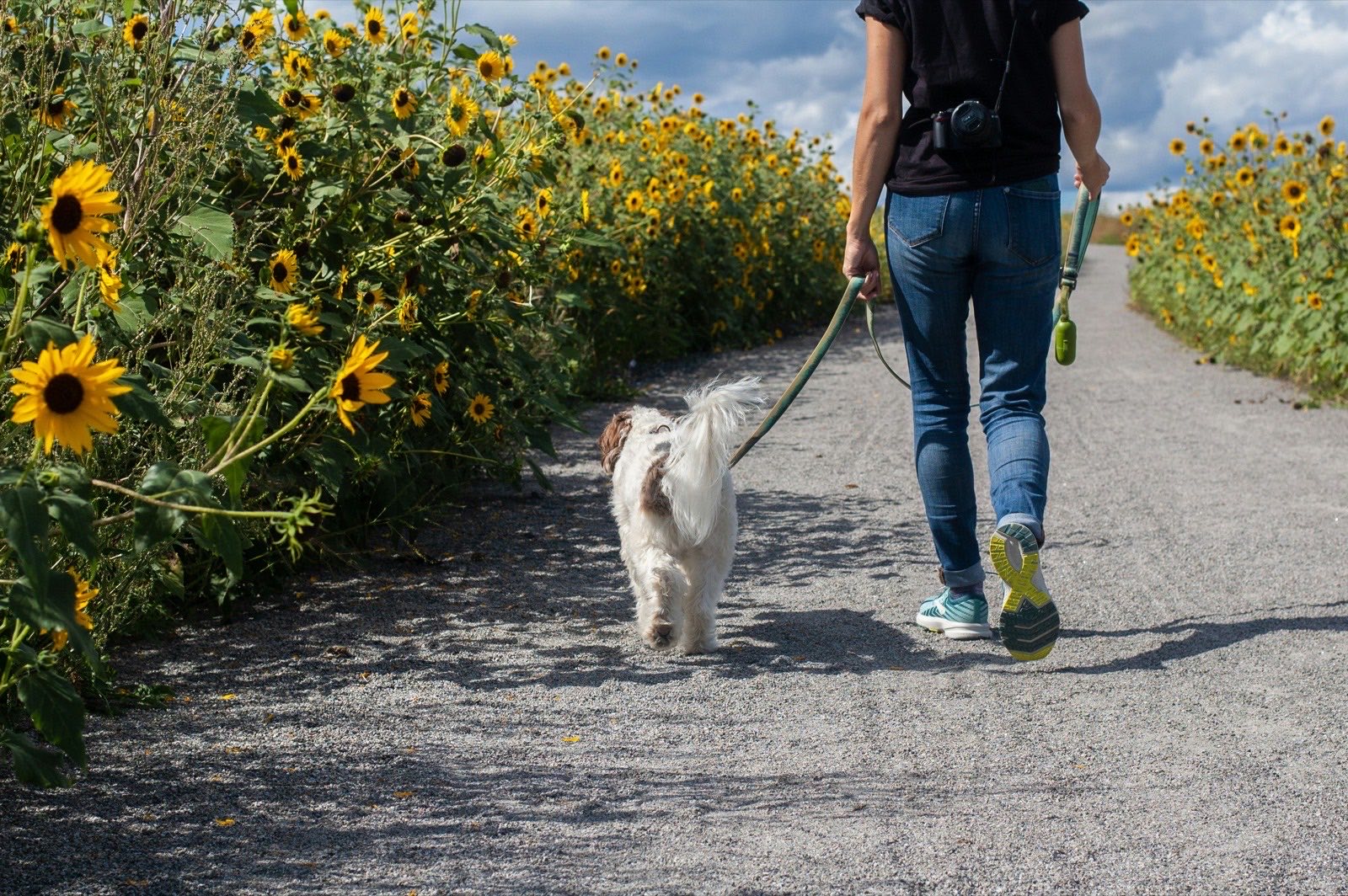
A 20-50ft line on a well-fitted harness gives your dog freedom and you a safety net, and it stops your dog rehearsing the habit of ignoring you. Every successful blow-off makes the next one more likely. Try these top parks in the Comox Valley for long-line practice.
Make the exercise easier, and pay better. If your dog can't recall off a squirrel, don't keep practising recall off squirrels. Back up to a distance and a distraction level where they can succeed, and raise the value of what you're paying with. Kibble worked in your backyard; there's a good chance it is not going to compete with all the fun things at the beach. This is the time for chicken, cheese, and being genuinely worth coming back to.
Stop repeating the cue. If you say "sit" and nothing happens, saying it four more times teaches your dog that "sit" means "sit eventually, or don't." Say it once. If nothing happens, that's information: the situation was too hard. Make a note, and set things up easier next time - somewhere with fewer distractions.
Protect their sleep. Adolescent dogs still need a lot of it - often 16 or more hours a day - and an overtired teenage dog is indistinguishable from a badly behaved one. A huge proportion of the "he's gone wild in the evenings" messages I get are a sleep problem wearing a training problem's coat.
Give them something to do with their face. Sniffing, licking, chewing and shredding are self-soothing for dogs, and adolescents need more of it, not less. A long decompression sniff-walk will do more for your dog's brain than another lap of heeling around the block. Appropriate chews are cheaper than furniture.
The trap to avoid
This is the stage where people get told to get tough. To use the prong, the e-collar, the alpha roll, the yelling - because the "nice" stuff has stopped working.
Here's the problem: the nice stuff hasn't stopped working. Your dog's brain changed, and the criteria needed to change with it. Escalating to pain or intimidation at exactly the moment your dog is developmentally more sensitive and going through a fear period is how you get a dog who is quiet but shut down, or worse, a dog whose reactivity gets significantly harder to fix. Suppressing the behaviour doesn't address the feeling underneath it, and adolescence is when a lot of feelings are being sorted out for good.
The dog you have at two years old is substantially shaped by what happens now. It's worth being patient with.
A note on spaying and neutering
You'll get a lot of confident advice about whether desexing will fix the behaviour, and about when to do it. Timing recommendations have genuinely shifted in recent years and they vary by breed, size, sex and individual circumstance. That's a conversation for your vet, with your specific dog in front of them - and it's worth knowing that it isn't a behavioural solution on its own. Surgery doesn't install impulse control.
The dog on the other side
Nothing you taught was lost. It's temporarily buried under hormones and poor judgement, and it resurfaces the moment you keep reinforcing it. That's the part worth holding onto: the work you do in these hard months isn't just getting you through them. It's building the dog you'll have for the next decade, and the owners who stay consistent now end up with a wonderful companion.
When to get help
Call a trainer if you're seeing barking, lunging, growling or snapping at dogs or people, if the fear responses are intensifying rather than passing, if you're avoiding walks, or if you've stopped enjoying your dog. That last one is a legitimate reason on its own - you don't have to wait until things are bad enough to justify it. Adolescence is the stage where a handful of well-timed sessions saves you a year of frustration.
Working through the teenage phase with your dog? Private coaching sessions are available throughout the Comox Valley, and group classes are a great way to practise these skills around real-world distractions.
You might also like
Ready to take the next step in your learning journey?
Explore training packages designed for dogs and owners just like you.
See Training Packages